

Friday, December 30, 2011
2011: The Year in Culture

Thursday, December 29, 2011
The Top Ten Movies of 2011
 I saw a lot of films this year but ultimately I found 2011 to offer a relatively meager selection of good movies. I failed to warm to Terrence Malick's Tree of Life the way others have (I'm still not sure what that movie is about) and actually didn't find my favorite film of the year until I saw it a week ago. But if I struggled to find movies I loved, there were plenty I liked and a few I was fond of even if they were imperfect (Kenneth Lonergan's Margaret is a good example). Below are my favorite films of 2011:
10) Melancholia
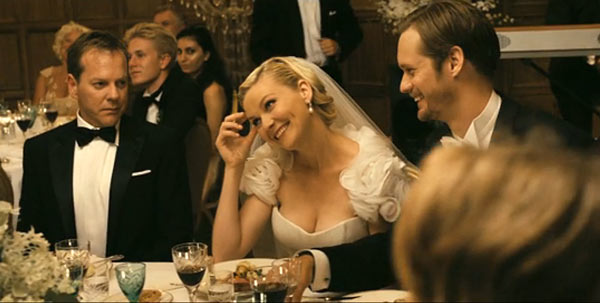
Lars Von Trier's latest is a story about the end of the world and, more disturbingly, what it feels like to think the world is ending. As with all of Von Trier's films, the themes are not particularly life-affirming, but the technical mastery is top-notch and this time around the aesthetics are beautiful. In chronicling one woman's (a marvelous Kirsten Dunst) depression, Von Trier's has found a natural vessel for his characteristic misanthropy. And yet, the film leaves a mark more triumphant than pessimistic -- you leave the theater much happier than any of the film's characters.
9) Contagion
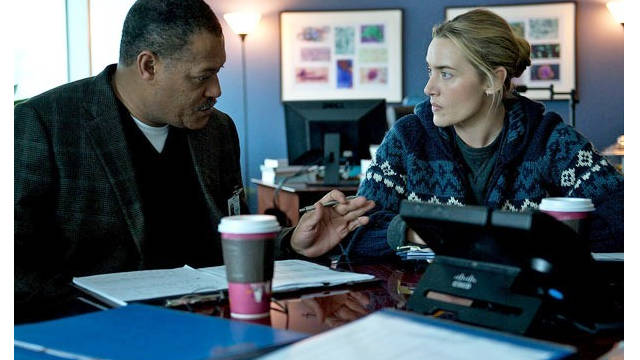
Director Steven Soderbergh looks at the spread of a viral pandemic with an appropriately clinical eye, giving equal attention to the ensuing hysteria and the work of managing it and finding a cure. The scenario is terrifying -- you'll never look at the spread of germs the same way -- which only makes the resolution all the more exhilarating. With an excellent ensemble led by Kate Winslet, as a CDC agent managing the response, and Jennifer Ehle, as the researcher who finds the cure, Contagion interweaves a variety of stories about the impact of the virus, and while some are markedly more effective than others, the film as whole is at once harrowing and thrilling.
8) Margin Call

JC Chandor's debut film is surprisingly compelling for how much of the movie is just talk. Set in the New York offices of an investment firm on the eve of the financial crisis, Margin Call tells the story of the crisis from the eyes of the bankers and analysts who were responsible for it. But the film is more Mamet than Wall Street -- Chandor is less interested in the details of what happened than in the underlying motivations and emotions that make these men (and one woman) tick. With a stellar cast led by Kevin Spacey and Zachary Quinto, Margin Call is a small movie that makes a big impression.
7) Take Shelter

About 98% of Take Shelter is fantastic. And then that last 2% is...frustrating, but I'll get to that later. In Jeff Nichols' haunting film, Michael Shannon plays Curtis, a man who starts having apocalyptic visions and begins mortgaging his financial well-being to prepare for their potential fruition. As his neighbors and eventually his wife (Jessica Chastain) start worrying for his mental health, Curtis continues his mission unabated, walking ever so dangerously on the edge of sanity and financial ruin. Take Shelter is fascinating as blue collar allegory of our modern day depression -- the paycheck to paycheck living that leaves everyone vulnerable. And it's also a searing portrait of obsession, as Shannon gives an indelible performance as a man committed to protecting his family in the face of unbelievable visions. I didn't love the ending because I found it unnecessary, but it's in keeping with movie's ongoing suggestion that modern living is far more precarious than we realize.
6) Bridesmaids

The best comedy of the year, Paul Feig's Bridesmaids is an uproariously funny story of Annie (Kristen Wiig) and her ongoing failures at being a good maid of honor to her best friend (Maya Rudolph). More impressively, the film is also emotionally honest, capturing not just the hilarity but the real life anxiety, insecurity, and competitiveness that all thirty-somethings feel as they watch their friends move to different stages of life. But ultimately it's the funny moments that make this film great -- the dressing room scene alone would have earned Bridesmaids a spot on my list.
5) Martha Marcy May Marlene

The most impressive debut of the year, Sean Durkin's psychological thriller about a young woman named Martha (Elizabeth Olsen, in a breakthrough performance) who escapes a cult is an ingenious exercise in structure and form -- Durkin keeps his audience in a state of anxiety similar to Martha's, as both what she experiences and what we see remain slightly off-kilter. In flashbacks to Martha's time under the spell of her cult leader (John Hawkes), we see the root of her unease and the seductive nature of his charm. And by the end of the movie, we realize Durkin has cast a spell of his own.
4) The Interrupters

The best documentary of the year, Steve James' The Interrupters follows members of Chicago's CeaseFire, a group of ex-cons and former gang members who try to interrupt urban violence before it claims lives and escalates into street warfare. James, as he did in Hoop Dreams, shows admirable restraint with his camera and is rewarded for his patience -- the footage he gets is both gripping and eye-opening. What he captures is the systemic nature of the causes of urban violence -- the culture and situations that lead to unnecessary deaths and urban decay. But The Interrupters is important not only for its lens on our society's problems, but also for its focus on the many reformers who have escaped past mistakes to lead lives of incredible integrity and courage. They may be fighting an unwinnable war, but the violence interrupters offer inspiration in every battle they fight.
3) Hugo

Martin Scorsese's tribute to the cinema of yesteryear is disguised as a children's tale about an orphan living in a Paris train station, but don't let that fool you -- Hugo is about much more than the adventures of a child. Rather, Scorsese uses Hugo's story as an entryway to tell the fascinating tale of film pioneer Georges Méliès (Ben Kingsley), who in old age is forced to work at the same Paris train station that houses the story's titular character. It's only appropriate that Scorsese uses this story, about a cinematic innovator, to pursue his own experiments in innovation -- Hugo is notable not only for its lovely story, but also its subtle and effective use of 3D, which is put to better use here than it has been since Avatar.
2) Certified Copy

At the start of acclaimed Iranian filmmaker Abbas Kiarostami's latest film, we watch an art historian (William Shimmel) take a seemingly innocent trip with a Frenchwoman (Juliette Binoche) who appears to be a fan of his work. But over the next two hours, the relationship starts to evolve and change in ways that are bewildering and fascinating, and it becomes clear that Certified Copy is a relationship drama where the central question is about the relationship -- is it old or is it new, is it significant or is it all just a game? Certified Copy suggests that whether real or fake, a genuine article or an artificial copy, the emotions and memories can be resonant and meaningful in any case.
1) A Separation

I didn't anticipate that my two favorite films of the year would be foreign ones (let alone both by Iranian directors!), but when I saw A Separation last week, I knew it was my favorite film of the year. Asghar Farhadi's domestic drama initially appears to be about an Iranian couple's impending divorce, but it soon turns into a much bigger tale about the impact of that separation -- on the care of the elderly, on the well-being of the children, on the couple's status under the law and in their community. By constantly shifting the perspective and withholding just enough information to make the audience feel secure in their judgment, Farhadi undermines expectations and lets sympathies shift so that by the end everyone and everything we've seen is clouded in ambiguity -- just like life itself. A Separation is a remarkable feat of storytelling and the best film of the year.
Top Ten Television Shows of 2011

As bountiful as the year was in terms of good television, there were fewer great new shows in 2011 than in past years -- only two series that premiered this year made my top ten (though I did not get a chance to see Showtime's Homeland, which debuted this fall to acclaim). Still, the good programs that returned were in fine form, both in drama and in comedy. Below are my favorite TV shows of the year (note there will be spoilers in some of my write-ups):
Honorable Mention:
Bob's Burgers (Fox); Happy Endings (ABC); Men of a Certain Age (TNT)
These three TV programs fell just shy of making my top ten, but I wanted to give them some attention since they're all worth watching. Bob's Burgers, the best program on Fox's animated comedy block, is a strange and often hilarious show about an eccentric family that runs a burger shop. The voice actors are phenomenal -- particularly Kristen Schaal and Dan Muntz as Bob's daughters -- and the writing is very sharp, making it my favorite new comedy of the year.
ABC's Happy Endings, meanwhile, started off as a generic Friends retread but slowly evolved into something more distinct, taking full advantage of its talented ensemble of young comedic actors to tell stories that are often very silly and also very funny. Adam Pally, as a gay character who is pretty much the opposite of the stereotype, tends to steal the show, but the whole cast is very likable. It's the best Friends clone since How I Met Your Mother.
TNT's Men of a Certain Age was canceled after its second season, which is a pity because the show was unique for its understated examination of the everyday obstacles and occasional victories that are a part of growing older. Ray Romano, Scott Bakula, and Andre Braugher, as the men of the title, gave impressive performances that made viewers care about the small scale dramas of the characters. The show is canceled, but Men of a Certain Age is worth catching on DVD if you haven't seen it.
Now to the top ten:
10) Treme (HBO)
In its second season, David Simon's series about New Orleans in the aftermath of Hurricane Katrina started to tell the story of the city's rebuilding a year after the storm, showcasing not only the political machinations involved in the redevelopment but also the devastating increase in crime and the strain on government resources that usually follow a destructive event. But as with Simon's best work, the sociological and political messages are secondary to the growth of the characters, and this year Treme told touching stories about many of them, such as Ladonna's (Khandi Alexander) difficult recovery after a trauma, and Antoine's (Wendell Pierce) efforts to get his own band off the ground. In the backdrop, the culture of New Orleans was portrayed as vividly as ever, enveloping the narratives and serving as a reminder of why The Big Easy is worth fighting for.
9) Downton Abbey (PBS)
I'll admit, Downton Abbey doesn't really add much to the existing collection of period British dramas that address the old world class structure and the upstairs, downstairs dynamics of lords and their servants. But damn if the show isn't so much gossipy, melodramatic fun. Immaculately capturing the early 20th century period in which its set, Downton Abbey focuses on the trials and tribulations of a noble family struggling to find a suitable heir, as well as the abbey's loyal servants who face their own series of challenges. While the characters are often one dimensional, the excellent cast and the deliciously arch dialogue are more than enough to keep you riveted. You can catch up on the short first season on Netflix streaming before the second one begins next week on PBS.
8) Game of Thrones (HBO)
Like Downton Abbey, Game of Thrones is another genre show, but also like Downton Abbey it quickly transcends the genre with its universal themes of duty and honor, superb writing, stellar ensemble cast, and incredible production values. In adapting George R.R. Martin's fantasy novels, creators David Benioff and D.B. Weiss have ably melded the necessary exposition with fantastic action (and, as fits a show on HBO, sex), creating a crossover hit that appeals to both fantasy fans and good television fans alike. The last few episodes in particular barreled forward with such momentum, piling on the double-crosses, deaths, and premonitions, that by the end of season one it took restraint on my part not to pick up immediately one of Martin's books to see what happens next.
7) The Good Wife (CBS)
When The Good Wife first premiered, the initial hook was its ripped from the headlines story of the betrayed wife of a powerful politician. It's to the producers' credit that they never turned away from that interest in the happenings of the real world and have instead embraced it, but without resorting to unsubtle Law and Order-style rip-offs of current events. Rather, The Good Wife stays relevant by incorporating very modern conceptions of technology and office politics into its byzantine story lines, and by letting each case of the week advance the development of the show's fascinating cast of characters. For three seasons in a row The Good Wife has been the most sophisticated drama on broadcast television.
6) Community (NBC)
Over the course of its three seasons, Community has proven itself to be the most inventive sitcom on television. Creator Dan Harmon builds episodes like puzzles, often using different perspectives, narrative structures, and homages to create fully-formed stories that manage to be groundbreaking and still consistently hilarious. This season alone brought episodes featuring different timelines, multiple genre homages, and, in my favorite episode of the season, a clip show with flashbacks to events that viewers hadn't seen before. Harmon's experimentation does not always yield magnificent results, but with a stellar cast and his able writing staff, the results are more often brilliant than disappointing. Here's hoping Community's upcoming hiatus from the NBC schedule will be brief -- I'm eager to see what Harmon comes up with next.
5) Friday Night Lights (DirectTV/NBC)
In its last season, Friday Night Lights went out on a triumphant note both for the series and for the Dillon Lions. Showrunner Jason Katims took a sizable risk when he introduced a whole set of new characters and retired some old ones, but by the end of the show we cared as much about the Lions' Vince Howard as we had the Panthers' Jason Street. And that's because, ultimately, Friday Night Lights was never very much about a specific football team; rather, it was about the community of Dillon and all the hopes, dreams, and challenges that found their way onto the football field. At the center of it all was one of the best marriages ever depicted on television, between Coach Taylor and his supportive wife (the superb Kyle Chandler and Connie Britton), guiding posts of support not only for the players and students under their watch but also for each other. They, and this wonderful show, will be missed.
4) Justified (FX)
In its debut season, Justified was a very good show that still struggled to figure out how to incorporate Elmore Leonard's distinct voice -- the show is based on one of his crime stories -- into a serialized drama about a trigger-happy lawman named Raylan Givens (Timothy Olyphant). By the end of the second season, those struggles vanished, yielding way to a fully-realized, perfectly wrought story of one man's relationship with his hometown and its history. Set in the deep Appalachia of Kentucky, Justified spent its second season focused on Raylan's entanglements with the Bennett clan -- controllers of the Harlan County pot trade -- and specifically their manipulative matriarch Mags Bennett (Margo Martindale, who deservedly won an Emmy for her performance). But in addition to the fascinating new characters, this season also added more depth to Raylan and his slippery adversary Boyd (Walter Goggins), creating rich stories that mined the shared history of the characters to full effect. The third season, which begins in January, cannot come soon enough.
3) Breaking Bad (AMC)
Vince Gilligan described his idea for Breaking Bad as the story of Mr.Chips turning into Scarface, and in its fourth season the transformation was complete -- Walt (the always amazing Bryan Cranston) ended the season in control of his fate, masterminding his way to freedom from Gus (Giancarlo Esposito, in the performance of the year) and a reconciliation with Jesse (Aaron Paul). Along the way, we were witness to some breathtaking scenes -- Breaking Bad continues to be the most visually arresting program on television -- that ratcheted the suspense to such incredible heights that you'd be forgiven for looking away. But that's what makes Breaking Bad such compelling television -- no show has a better understanding of pacing, patience, and how to deliver a payoff. If I didn't like this season as much as season three, it's only because the last minute twist left me slightly cold for seeming a little too clever. But that just speaks to what I've come to expect from this show -- and what better deserves our high expectations than the best drama on television?
2) Parks and Recreation (NBC)
The funniest comedy on television is also the sweetest, and that may be why Parks and Recreation is such an incredible show. Showrunner Michael Schur and his writers have created a world where even the silliest elements of the show are grounded by the heart of the characters and the skill of the performances. This season introduced a new crisis in Pawnee, as the Parks and Recreation division decided to put on a harvest festival to help address a budget shortfall. The episodes that revolved around the festival made up the most consistently funny stretch of TV all year, and also brought in new characters played by Adam Scott and Rob Lowe who fit perfectly into Pawnee's already expansive universe. Parks and Recreation is a comedy, but it delivers something more impressive than laughter: pure joy.
1) Louie (FX)
Louis CK's show defies categorization because it's unlike anything else on TV. I loved the show's first season, but nothing could prepare me for how bold and inventive the second season turned out to be. This season, CK delved even deeper into his profession, showcasing what it means to be a working comedian, often with the thanks of excellent guest stars like Joan Rivers, Dane Cook, and Doug Stanhope. But it's telling that CK is more interested in the lives of comedians than the comedy itself, since his show is ultimately about life -- what we're responsible for, how we should live, and what we shouldn't take for granted. He tackles these subjects through prisms as different as the Afghanistan War and evangelical Christianity, but underneath it all is his deep, abiding interest in how we behave and what we value. He's made the most humanist program on television and the best television show of 2011.
Subscribe to:
Posts (Atom)